
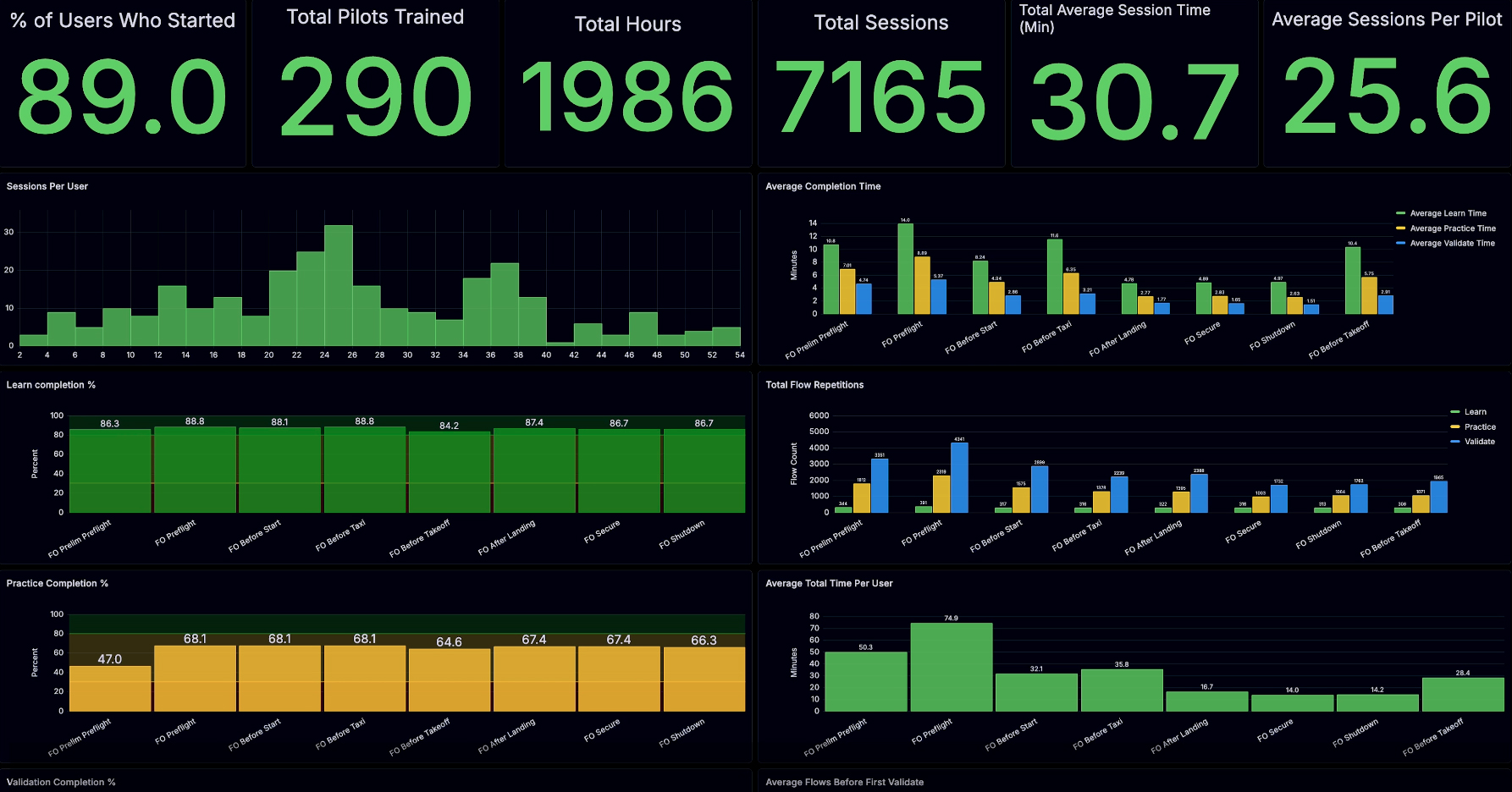
Aviation training generates more data than almost any other professional training environment. Every simulator session, every virtual reality (VR) procedure, every instructor debrief produces a vast array of output (e.g., behavioral data, performance data, biometric data, session telemetry, audio data); more than most of us know what to do with. Some of this data has suggested the need for alternative training and assessment frameworks to improve pilot training efficiency and effectiveness, such as Competency Based Training and Assessment (CBTA) and Evidence Based Training (EBT). However, the feasibility of applying CBTA/EBT ideology to today’s operational workflow is more challenging that it seems, primarily because training data is being collected through several proprietary platforms that work independently from each other. Regardless of which training approach ultimately prevails, one thing is for certain, any meaningful improvement to pilot training depends on three things working together:
1. The collection of large amounts of aviation data
2. The proper organization, processing, and cleaning of the collected data
3. The generation of reliable, context-aware insights that are simple enough for any pilot, instructor, or training organization to understand and act on
Given the large amount of data being collected by several aviation simulation environments, it is clear that the problem is not a shortage of data, but rather the fact that almost none of the data is structured in a way that can answer the questions training organizations actually need answered, including:
- Identifying if a checklist is poorly designed, confusingly worded, or requires a flow that is physically difficult to execute.
- Determining if a lack of recent exposure or a gap in the training syllabus is affecting the collective readiness of the pilot group.
- Differentiating between a random human error and a systemic "trap" in the flight deck environment that needs to be addressed through a Training Bulleting or updated simulator profiles.
These are concrete, operationally important questions that cannot be supported by data being collected in most simulation environments today, primarily because the data is collected across different proprietary platforms. This fragmentation makes the data largely inaccessible, as well as extremely difficult to combine into a meaningful way that can be used for advanced analytics and operational insights.
VTR’s FlightDeckToGo® was built to solve the data fragmentation problem.
Why Traditional Training Data Falls Short
The dominant data outputs of conventional aviation training are session-level summaries, time accrued, instructor evaluations, and pass/fail check ride outcomes. While these are important, they have fundamental limitations. For starters, they are episodic and aggregated. They tell you what happened at the end of a session, but not what was happening within a single session or across multiple sessions. They capture whether a pilot completed a procedure, but not how they executed it, how long each step took, or where their attention was during the steps they missed.
While pilot training practices are expected to continue evolving, it is important to highlight the fact that the limitations of current training data output require some reorganizing to properly support adaptive training tools that promise to optimize training throughput beyond what is capable of current training devices. This requires continuous, objective evidence of how specific competencies/skills are developing across the training lifecycle. That evidence cannot be provided by periodic snapshots and subjective ratings. It requires a different kind of data infrastructure entirely.
VR training environments come along with significant promise in this regard. They provide raw data that can be used to derive continuous output including interaction and sensor data, procedural execution and training performance data, behavioral and cognitive metrics, and even system and device data. But raw VR output does not automatically solve the data problem. It creates a different version of it: a high volume of behavioral signals with no reliable way to connect them to training-relevant performance constructs. FlightDeckToGo®’s architecture was specifically designed to turn this raw data into training data by connecting each behavioral signal to a specific procedural moment, an operational standard, and a consistent analytical context.
What Makes VTR’s Data Different
Most VR systems can collect sensor data as a byproduct of operation, but most VR curriculum providers don’t. Instead, they focus on simple forms of data collections like procedure completion rates and accuracy scores, which only tell part of the training and skill development story. Unsurprisingly, it takes expertise to know not only how to implement the sensor data into VR curriculum operations, but also how to process, analyze, and draw valuable insights from the more complex forms of data that VR can capture (e.g., fusion of eye tracking, hand and controller movements, biometric data). FlightDeckToGo® was designed from the ground up as a training-grade data infrastructure that leverages all these complex forms of data, which is a distinction that matters enormously.
In its current state, the platform captures simultaneous, synchronized streams across six modalities: eye tracking, head tracking, hand and controller movement, flight deck interaction events, scenario metadata, and instructional context tied directly to standard operating procedures (SOPs). All streams are time-aligned, so analysts can trace exactly what a pilot was looking at, where their hands were, and which step of the procedure they were executing, all at once. Data are sampled at a dynamic rate linked to the headset framerate, producing a continuous, high-resolution behavioral record. At scale, this means millions of synchronized data points collected across hundreds of active commercial airline pilots, with current deployments covering aircraft types that represent approximately 90% of global commercial aviation traffic by cycles. On top of that, every session is tagged with scenario type, procedure steps, SOP ground-truth labels, and aircraft configurations, as authored by aviation instructors and subject matter experts. Thereby, providing an objective standard of correct execution that performance signals are evaluated against. This is what separates training-grade data from data that merely looks like it could be useful.
What the Data Reveals
The depth of FlightDeckToGo®’s architecture unlocks a set of insights that conventional training systems simply cannot provide.
· Step-level procedural performance: Training organizations can identify exactly which step caused difficulty, how consistently it appeared across sessions, and whether it is improving. Providing instructors with a quick snapshot on a pilot’s full training experience, their strengths, their weaknesses, and all before ever stepping into a simulator together.
· What behavioural patterns precede errors: Procedural errors in aviation are rarely caused by a lack of knowledge. More often, they reflect microstates (e.g., overload, fatigue, confusion) that temporarily breakdown execution. Eye tracking, head movement, and session interaction data provide objective markers of why an error occurred, not just that it did. Making it possible to provide targeted feedback and early-warning indicators of performance breakdown.
· Longitudinal learning trajectories: Skills grow, plateau, and, without sufficient practice, decay. Because data is structured consistently across sessions, longitudinal trajectories can be tracked for each pilot on each procedure. Enabling proactive intervention before performance issues surface in higher-stakes environments.
· Fleet-wide systematic gaps: Consistent data structures across all users and deployments makes it possible to aggregate performance data fleet-wide to identify systemic patterns: procedures that are consistently difficulty, training stages where error rates spike, aircraft transitions that produce predictable performance dips. These patterns are invisible in session-level data and only become clear and actionable at scale.
A Different Kind of Training Platform
The gap between the behavioural data aviation training generates and the data it can actually use for decision-making is a structural problem, not a volume problem. More sessions, more sensors, and more platforms only partially fill the gap. What closes it is a data architecture that applies complex sensor fusion, task-grounded labeling, and operational context at the point of capture, so that what comes out of each session is already organized around the questions that matter. With FlightDeckToGo® there is a clear distinction of what was possible before and after data infrastructure like this.
· Before, instructors coached from memory based on infrequent sessions, analysts approximated fleet trends, and pilots had no objective record of how their own proficiency was actually developing within and between sessions.
· Now, every session produces a structured behavioural record (step-by-step, pilot-by-pilot) that can be directly examined.
For flight instructors, that is the difference between a debrief based on observation and one based on evidence-informed insights. For analysts, it is the difference between estimating where fleet-wide error patterns exist and knowing exactly where they are with objective data. For pilots, it is a trend line and adaptive training feedback where there used to only be a gut feeling. For researchers, it is access to longitudinal, multimodal datasets with verified performance benchmarks that laboratory paradigms have never been able to produce. FlightDeckToGo® not only changes what training looks like, but what you can know from it, and it turns out to make all the difference.


